
Meowdoku: Brain Puzzle Games review
 Analysis by GetAllApps
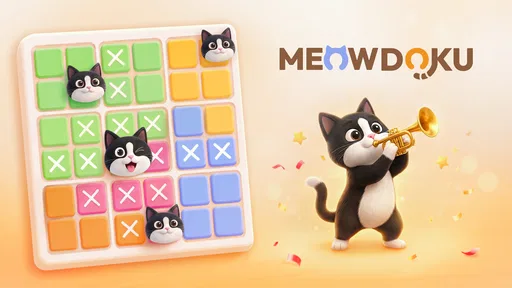
Some puzzle games make a strong first impression with elaborate worlds or flashy effects. Meowdoku: Brain Puzzle Games takes a quieter route: it frames a logic challenge around cats and their territories, then invites you to slow down and work things out. Its central idea is easy to grasp, but the mix of Sudoku and Minesweeper gives each puzzle room to ask for careful attention. I find that combination appealing when I want a game that feels thoughtful without demanding a long session of dramatic action.
Made by Oakever Games, this free puzzle game has a welcoming premise and an identity built around its feline theme. It has earned a 4.7 average from around 546,000 ratings, and its broad audience is reflected in an Everyone content rating. Those figures suggest that the game has found plenty of players, but the more important question for a puzzle fan is whether its theme and rules work together. In my view, the territory concept gives the logic a clear purpose: you are not simply filling a grid, but figuring out how the cats fit into it.
A gentle first impression with a clear puzzle hook
The title communicates the game’s personality straight away. “Meowdoku” is playful, while “Brain Puzzle Games” points toward the more deliberate activity underneath. That contrast is a useful introduction to the experience: the subject matter feels light, yet solving a board depends on observation and deduction rather than reflexes. I like that the premise gives the puzzles a bit of character without obscuring what kind of game this is.
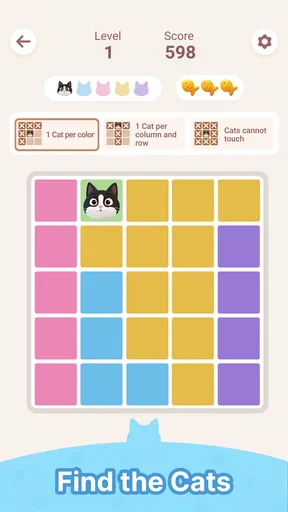
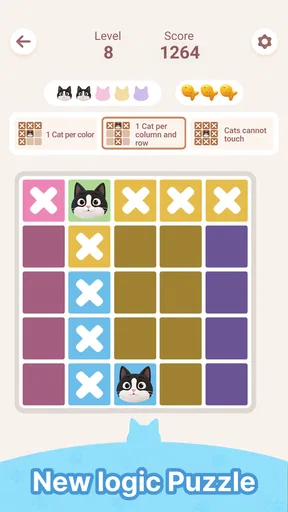
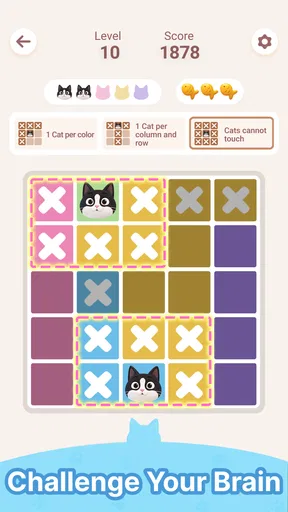
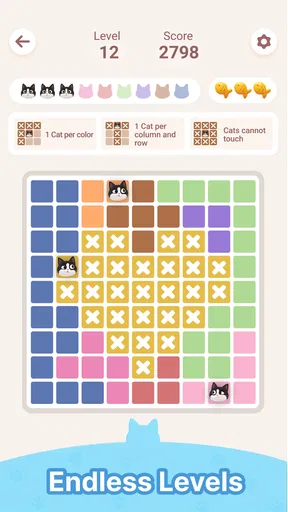
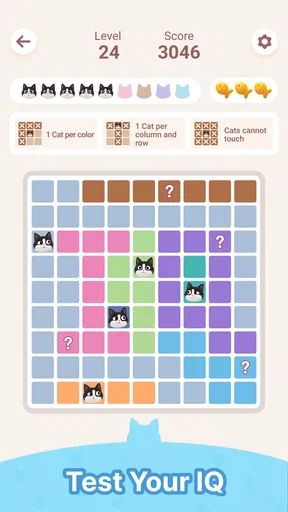
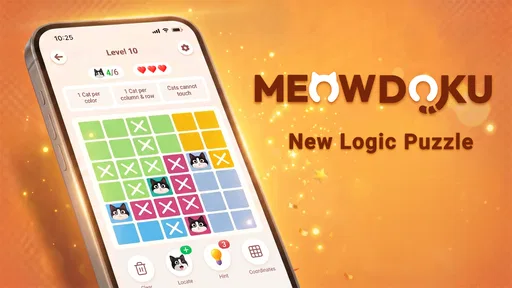
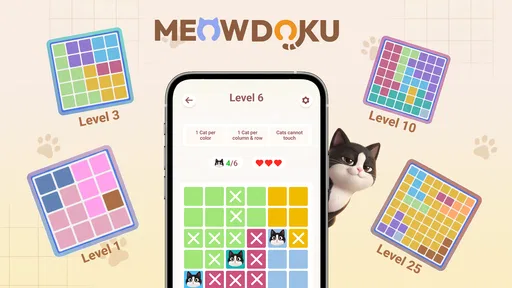
The store description sums up the core idea as a pure logic puzzle blending Sudoku and Minesweeper, with the goal of finding every cat’s territory. That is a compact hook, and it gives new players a reasonable picture of the challenge before they begin. Sudoku is associated with orderly deduction, while Minesweeper asks players to interpret clues and make sense of hidden relationships. Bringing those familiar puzzle traditions together gives the game an understandable foundation, even for someone arriving primarily for the cats.
The first impression is therefore less about spectacle than coherence. The feline theme is not presented as a separate attraction beside the puzzle; it is tied directly to the task of identifying territories. That connection matters because a theme can easily feel pasted on to a logic game. Here, the premise makes the abstract act of examining a board feel more specific. I am not just searching for a solution in the abstract; I am trying to understand where each cat belongs.
The strongest part of the pitch is how quickly the theme and the objective point in the same direction. That makes the game easy to recommend to players who enjoy Sudoku-style thinking but might like a little more personality around the grid. It also gives casual puzzle fans a simple reason to try it, without suggesting that the challenge is merely decorative or automatic.
A feline theme that gives the grid a sense of place
Cat imagery brings an immediately approachable tone to a genre that can otherwise look austere. A plain grid can be satisfying for dedicated logic fans, but a recognizable theme helps make the activity feel warmer and more inviting. In Meowdoku, the cats are not just a cute label: the idea of finding each one’s territory gives the board a setting, however minimal. That small shift gives the puzzle a sense of place.
The available description supports a restrained reading of the presentation. It establishes cats and territories as the defining theme, but the appeal does not depend on imagining a sprawling story or a detailed fictional world. Instead, the setting is a compact frame for reasoning. I think that is a sensible choice for a game whose primary pleasure comes from noticing patterns and drawing conclusions. The concept adds charm, then leaves the puzzle itself in the foreground.
That balance also helps the game feel accessible. A player does not need to learn a complicated fictional vocabulary before understanding the goal. The image of cats occupying territories is familiar enough to make the board’s purpose intuitive, while the Sudoku-and-Minesweeper blend supplies the intellectual identity. The result is a clean meeting point between theme and system: the cats make the puzzle inviting, and the logic gives the theme something meaningful to do.
For me, this is where the game’s art direction matters most as an idea, even before considering any particular visual flourish. A coherent visual mood is not only about decorative detail; it is also about whether the presentation suits the pace and nature of play. A calm, cat-centered concept is a natural match for pausing over clues. The theme encourages a relaxed attitude, while the board asks for concentration. Those qualities complement rather than compete with one another.
Sound and rhythm in a game built for thought
Sound can make a puzzle feel satisfying, but it can also become an interruption if it pushes too hard against the player’s concentration. For a game centered on pure logic, the ideal mood is one that gives the mind room to work. Meowdoku’s premise points toward that kind of experience: the challenge is about examining clues and finding territories, not reacting to a fast-moving sequence of events. Its appeal is therefore naturally tied to a measured rhythm.
I find that pacing especially important in a hybrid of Sudoku and Minesweeper. Both styles reward patience, and their pleasures come from the moment when a clue starts to make sense. The game’s core concept invites players to move between looking at the board, considering what they know, and deciding what follows. That rhythm can make a puzzle feel active without requiring speed. The attention comes from the reasoning, not from a timer or a rush of action.
The cat theme helps reinforce a softer mood. It gives the experience a friendly identity, while the logic keeps it from feeling empty or purely ornamental. That combination is appealing for short breaks: I can approach the game with a relaxed mindset, then engage more deeply once I start tracing the relationships between clues. It is a good fit for anyone who enjoys a quiet challenge that still asks them to think carefully.
Rather than judging a puzzle game by how much noise or motion it puts on screen, I prefer to ask whether its overall tone supports the activity. Here, the idea of cats and territories suggests an approachable, unhurried setting, while the Sudoku and Minesweeper influences provide the mental structure. That is a coherent tonal direction. The game’s identity works best when its presentation leaves space for concentration and lets the satisfaction of solving a board provide the payoff.
Where the mechanics and theme meet
The central mechanic is the most compelling part of the concept. Sudoku and Minesweeper are both recognizable, but they ask players to think in different ways. One is closely associated with arranging information through logical constraints; the other with interpreting clues in relation to a concealed layout. A game that blends them has a natural opportunity to make each observation matter. The territory goal then gives those deductions a thematic result.
That blend is also the point where the game has to earn its name. Familiar ingredients are not enough on their own; they need to feel like parts of a single puzzle rather than unrelated references. The territory framing helps bridge the gap. It gives the player a reason to connect what appears on the board with a larger arrangement, and it makes the cats part of the puzzle’s logic instead of simple decoration. As a result, the concept feels easy to explain while still promising room for thought.
The store describes the game as a pure logic puzzle, which sets an expectation of reasoned solving rather than guesswork as the intended appeal. That is a useful signal for players who enjoy deducing answers from available clues. It also makes the game’s pacing feel appropriate: a good logic puzzle should give you time to examine what you know, test an inference mentally, and reconsider when the pieces do not line up.
Its best design idea is the way a familiar logic challenge gains a simple, memorable purpose through cat territories. That purpose is approachable without making the underlying task sound trivial. I would recommend the game to players who enjoy grid-based puzzles and want a theme with more personality than a bare collection of numbers. It may also suit someone looking for a gentle mental workout, provided they enjoy taking a methodical approach rather than expecting an action-heavy game.
The game has reached over 10 million installs, and its current version is 1.22.0. It is free to play, with in-app purchases ranging from $3.99 to $69.99 per item. Those details are useful context for anyone deciding whether to download it: the core entry point costs nothing, while optional purchases are available. Its broad player base and strong average rating make it a prominent choice in the casual logic-puzzle space, though whether the style clicks will still come down to a player’s taste for careful deduction.
Who is likely to enjoy the experience?
Meowdoku is a natural match for fans of Sudoku, Minesweeper, and other games where each clue can narrow down the possibilities. If you enjoy solving a board by paying attention to how its parts relate, the premise should be easy to appreciate. The cat theme adds warmth, but the main attraction is still the process of reasoning your way toward a complete picture.
It also has an approachable identity for players who might find a more clinical-looking logic game intimidating. Cats give the concept a friendly point of entry, and territories make the objective easy to picture. That does not remove the need to think; instead, it frames the challenge in a more playful way. I see that as a real strength for a puzzle game intended to appeal beyond dedicated number-game fans.
Players who want constant novelty from a story, high-speed competition, or action-oriented mechanics may be looking for a different kind of experience. This game’s identity is quieter and more focused. Its appeal lies in settling into a puzzle and letting the clues guide the next step. That makes it a good option for a calm break, a few minutes of focused play, or a longer stretch of methodical problem-solving when the mood strikes.
The age rating is Everyone, which supports its broadly accessible presentation. Its minimum operating system requirement is Android 7.0. Taken together with the gentle feline premise, those details help position it as a straightforward casual game rather than a niche puzzle designed only for experts. Still, the Sudoku and Minesweeper influence means it has an obvious target audience: people who like to think through a board instead of relying on luck or quick reactions.
A coherent little world for logic fans
What stays with me about Meowdoku: Brain Puzzle Games is the way its mood and mechanics reinforce each other. The cat-and-territory concept gives the grid a friendly setting, while the combination of Sudoku and Minesweeper supplies a clear intellectual challenge. The result is a puzzle game with an easy-to-understand identity and a reason to pay attention. It does not need an elaborate premise to make the act of solving feel purposeful.
I would describe it as a relaxed but focused choice for anyone who likes logic games with a bit of charm. Its atmosphere is best understood as supportive rather than showy: the theme makes the task inviting, and the measured nature of deduction lets players concentrate. That coherent mood is valuable in a genre where presentation can sometimes feel like an afterthought. Here, the cats and territories give the challenge a recognizable personality without taking over the experience.
Overall, I think Meowdoku is worth considering if you want a free puzzle game that combines familiar logic influences with a playful premise. It is approachable in concept, centered on reasoning, and well suited to players who enjoy taking their time with a board. The strongest recommendation is simple: if the idea of discovering where every cat belongs sounds more appealing than racing through a level, this is a charming way to give your brain a thoughtful workout.
Pros and cons
Pros
- Combines familiar Sudoku rules with a playful cat theme.
- Short rounds make it easy to play during spare moments.
- Grid puzzles offer a relaxing alternative to fast-paced games.
- Simple controls are suitable for players of different ages.
- Progressive challenges can keep puzzle fans engaged.
Cons
- Some puzzles may feel repetitive after extended play.
- The cat theme may not appeal to every player.
- Later levels can be challenging for casual players.
- Frequent play may require patience with slow puzzle solving.
- Puzzle gameplay offers little variety beyond the core grid mechanic.


